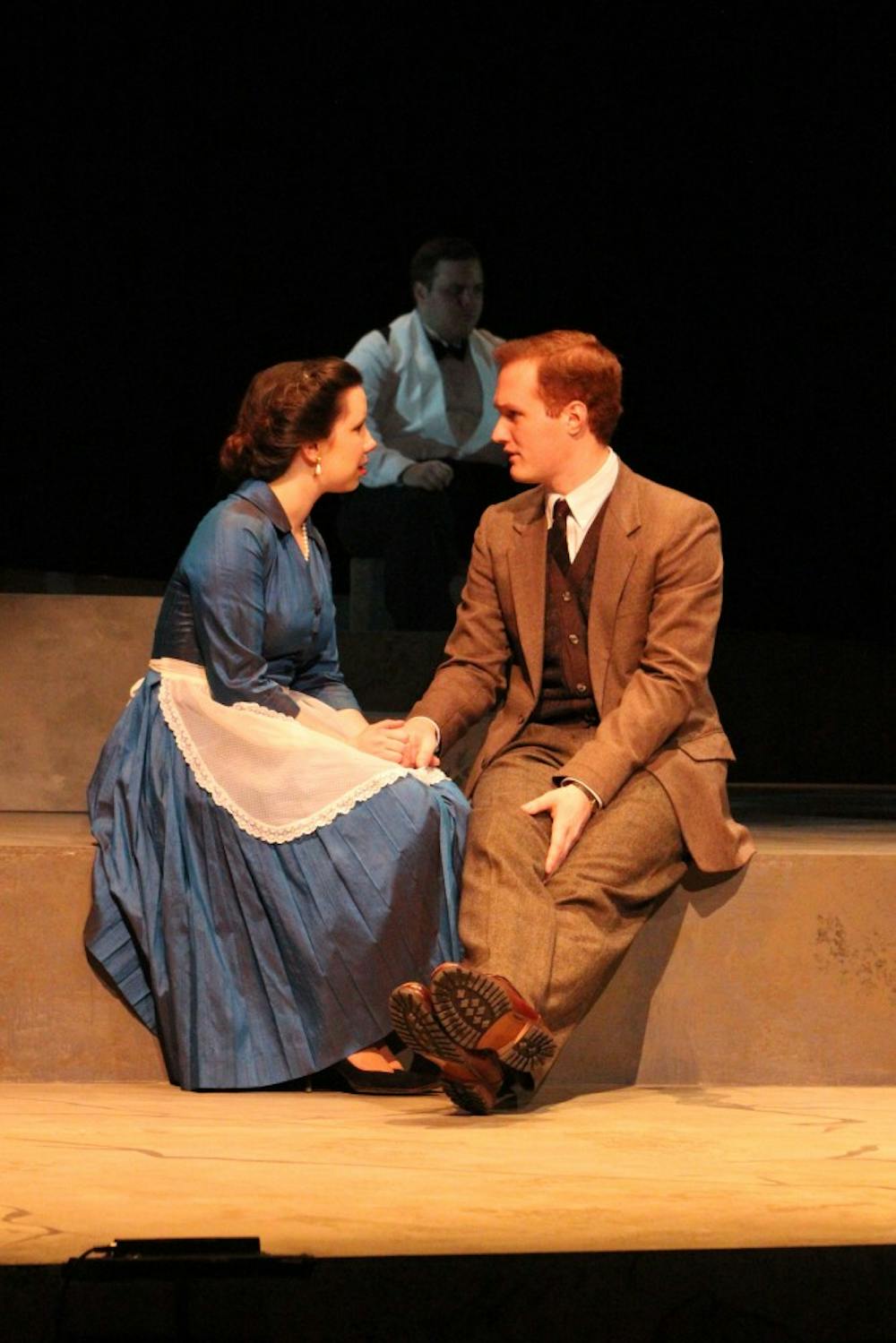
Soothing, light piano jazz music plays softly in the background as the audience waits for the play “After the Fall” to begin. The set is intriguingly set up and adds to the ambiance set by the music. The stage is tilted and there are many steps and levels that each resemble a different place. The background is a dark canvas that has three abstract images. On the far left there is a lamp post, in the middle a tree and to the far right a watch tower from Germany.
When the play starts, the actors pose onstage and Quentin begins to speak. He talks out to the audience as if there is someone else there that we cannot see. At first it is difficult to grasp what is happening on stage, but eventually the various flashbacks throughout Quentin’s life began to take shape.
The memories seem disjointed at first, but eventually the underlying story comes through. Quentin speaks of the many people he has cared for and lost throughout his life and his numerous conflicting emotions associated with those individuals. Some of the themes and emotions he experiences are guilt, lies, love, hope, sorrow, loss, power and fear. He is confused and by drawing on his memories, he is able to explain himself. It seemed that certain characters each represented one of these emotions to Quentin, and he is able to take away something from those relationships even if they did not last.
Even in a particular memory, other memories contribute to the scenes, adding a sense of confusion. A lot of the conversations were one-sided, either because he is talking to the unseen offstage individual or his memories are talking to him at a different time. Quentin always acts defensively when talking to the women in his past he had been romantically involved with. Louise, his first wife, articulates the fact that Quentin is unable to emotionally connect with women.
Every time he argues with another woman, she comes onstage and repeats herself. Holga is Quentin’s girlfriend, and she is the one who is always strong and hopeful. Maggie is the innocent one, and Quentin is drawn to her because of that and the fact that she does not pretend. She is simply herself and is happy that way. At times he would be in a memory with one woman and another would appear in the background and repeat a line she had said earlier.
All of this contributes to the idea of great inner turmoil for Quentin. From family, women, friends and his job, all of these things are the sources of his conflicting emotions. He and his co-workers face the possibility of losing their jobs. This stress tears their friendships apart and one friend even dies. While Quentin is trying to deal with these emotions, the audience is able to see the type of man he became.
He lies to protect someone he loved, but that did more harm than good. The mistakes he made and the lies he told factor in when trying to understand the decisions he made and how Quentin came to be the person he is now. His family played a big role in his life. His mother and father fought when he was younger and when he wanted to leave, his mother was supportive, but his father did not understand. He struggles to find himself by going through his past and tries to understand where things went wrong.
Overall, this play is extremely intense and powerful. All of the actors displayed an enormous amount of passion for their roles, particularly Emily Vanni and Sam Ray. This play was well done, and it is apparent how much effort and hard work was put in by everyone involved.
The lighting was another contributor to the intense feel of the play by emphasizing the importance of the scenes and whoever is talking. Each character was in a spotlight when they spoke, and the background lights were an indication of whether protagonist Quentin’s memories were taking place in Germany or back home.