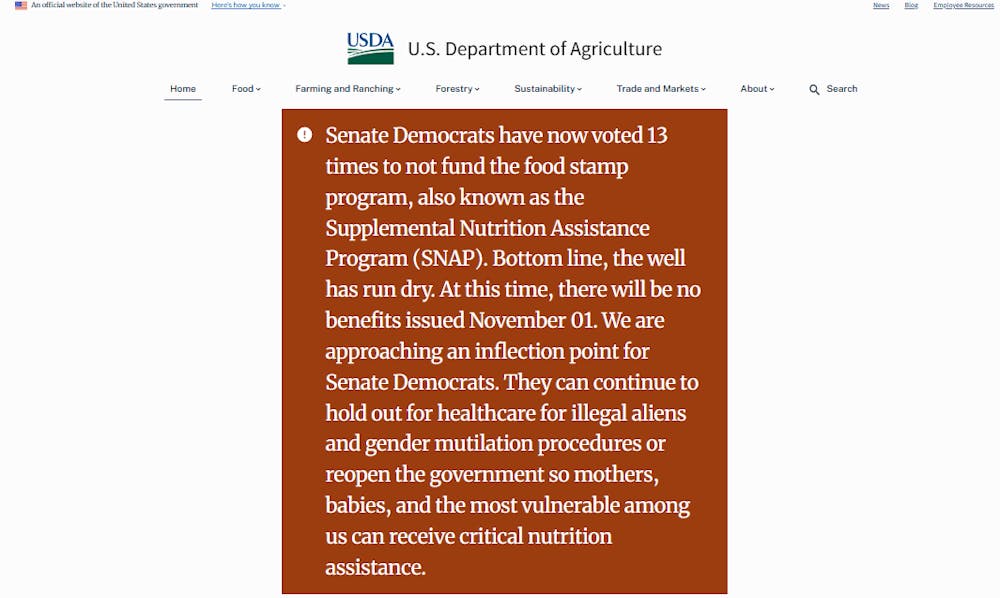
UPDATE: On Nov. 3, the Trump administration said it would only provide partial SNAP payments for November, and did not specify when the payments would be made. Students in need of food assistance should go to the Promise House or WARM.
Otterbein’s Promise House is seeking more food donations due to anticipated increased food insecurity following the end of SNAP benefits on Nov. 1.
“We are always in need for more donations," a Promise House student worker said. "Our pantry goes empty really fast, probably related to SNAP benefits going away, and students are always in need, so we always need more donations.”
The federal government shutdown can be cited for the end of SNAP benefits. The standoff stems from disputes over a bill funding government services. Democrats are holding out hope to get increased Medicare funding, while Republicans refuse to make a deal, believing that Democrats will face increased public pressure. A federal judge ruled on Oct. 31 that the Trump administration must allocate funds to continue SNAP as soon as possible.
SNAP, also known as food stamps, is a supplemental nutrition assistance program that provides food to low-income individuals. Through a more analytical lens, SNAP is a program that is designed to manage food costs for people whose income is at or below 130% of the federal poverty line. Since the government shutdown began on Oct. 1, all funding for programs such as SNAP has been halted, which means that everybody dependent on SNAP will be unable to use that resource.
For individuals in the Westerville area looking to take action, the two best locations you can donate to help the cause are WARM at 150 Heatherdown Dr. and Otterbein’s Promise House at 86 W. Home St. The most common needs for these food banks are canned meats, canned beans, pasta, peanut butter, soups, rice, canned veggies, condiments, bread, nuts, dairy, ramen, toilet paper and paper towels, common toiletries, and old clothes. If none of these are available, they also accept financial donations on their respective websites.
As of Oct. 30, Ohio Governor Mike DeWine signed an executive order providing $25 million for food relief. The order allocates $7 million to various food banks around Ohio, using Temporary Assistance for Needy Families (TANF) funds. The remaining $18 million will go to Ohio Works First (OWF) recipients, approximately 63,000 people. Columbus has also allocated $25,000 in emergency funding to the Mid-Ohio Food Collective.
The campus community has differing opinions on the issue of SNAP being paused. Logan Cassell, a freshman who is double-majoring in young adult education and history, said, “I think it’s, first of all, wrong. People need to eat. It’s a necessity.”
Freshman Elise Sepesy said, "I mean I don’t really have an opinion; I don’t really care."
Freshman Megan Donaugh said, “I don’t think it’s a good thing; I know people who rely on them. It doesn’t affect me directly, but it does affect the people I care about."
Deborah Stiglianese, an employee of the Business Office, said that they do have an emergency fund for employees. The emergency fund has some stipulations, however. It is a maximum of $300 per fiscal year to be spent on a bill rather than loose funds.
Kelly Dolin, the student accounts manager, clarified that the emergency fund is for staff, not faculty. Dolin also mentioned the 2024 staff assembly fundraiser, which included a silent auction and luncheon and was funded by the president’s office. She said that they raised $5040 for Otterbein employees, WARM, and the Promise House.
Promise House staff member, Karli Walsh, said, “We’re entering unknown territory. This is the first time something like this has happened before. We are bracing ourselves for an influx of people needing support.”
“Food is a part of who we are, and some people are going to have to forgo the cultural element of food to satisfy the necessity of food,” said Walsh.
Promise House is in communication with WARM to create a strategic plan on how to move forward. There is also major concern around food access for those who have dietary restrictions. “SNAP gives people the freedom to choose,” Walsh said.
Walsh also said that there is a large need to destigmatize food insecurity surrounding SNAP going away; students are scared for their next meal, and the Promise House is a resource to help. “If you need food, the Promise House is your campus resource.”
Besides donating food, Walsh encourages people to donate money to food pantries as well. “Food pantries also need fresh produce, dairy products, and frozen meals, so donating money provides the opportunity to do that.
45% of Otterbein students are eligible for the Pell Grant, which means that they meet the federal definition of having financial need. Many of those students also qualify for SNAP benefits.