
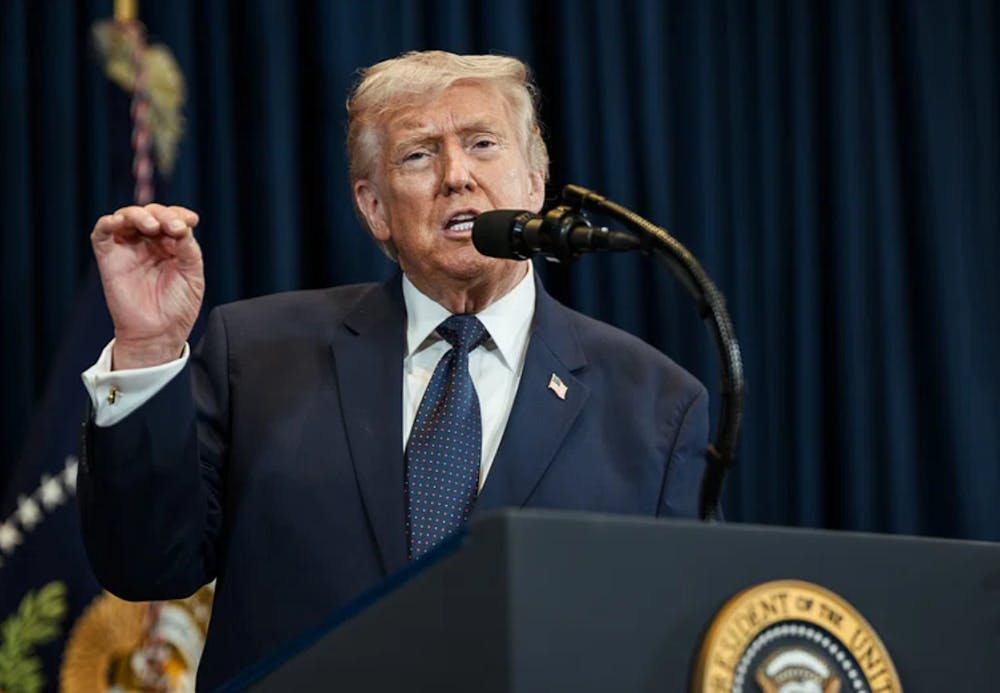
June 16, 2015 will go down as a date that launched a new era of American politics. It was on this day that Donald Trump — at that point a famed businessman, reality TV show star, and pop-culture icon — descended the golden escalator at Trump Tower in New York City and delivered the speech that launched his presidential campaign.
Eight eventful years later, Donald Trump has become one of the most controversial names in the world. However, in the endless sea of disagreement about Trump, one thing should be undisputed: he’s had one of the most unique and consequential political careers in American history.
So, what are we to make of the MAGA movement a decade later? Are those consequences positive or negative? Like seemingly everything in politics, it depends on who you ask.
Nicholas Robinson, a political science professor at Otterbein, and John Nestor, a legislative page at the Ohio Statehouse, gave their points of view regarding the legacy of the Trump era and the future of American politics after his administration.
Nicholas Robinson, PhD. — Assistant Professor, Department of History, Political Science, Languages & Cultures
What makes the MAGA movement historically unique in the grand scheme of American politics?
"The slogan 'Make America Great Again' was actually first used by Ronald Reagan in the 1980 election, so the idea has precedent, even with a recent Republican president. What makes Trump’s MAGA movement such a departure from American politics is the real weakening of the Republican Party. Historically speaking, American political parties have had strong control over their movements and who would represent their party. With the introduction of primaries in roughly the 1970s, parties became more democratized and lost significant power over who represented to the voters. Where MAGA is a sharp departure from this is it is much more of a personalistic movement. It is not establishment politicians that are being appointed into positions of power; it is those who align themselves closely with Trump and the movement."
When future generations look back, what do you think the political legacy of Donald Trump will be?
"Because the country has become so polarized around his presidency, it will entirely depend on who you ask. To his supporters, they will see the Trump era as a time where we moved politics closer to the people. They will see him as someone who rescued the U.S. from the establishment. His detractors will say the opposite of those things, that he was corrupt and was out for his own interests."
Going forward, what do you think the MAGA movement will represent to American history?
"We don’t share any consensus anymore. There is a large number of people on both sides that think the other is not just wrong or stupid, but is equal and wicked. It’s hard to say what we all will think the movement represents, but I think it’s safe to say it will represent something significant for everyone."
John Nestor — Secretary for Turning Point USA at Otterbein, legislative page at Ohio Statehouse
How do you feel public involvement and perception of politics have changed since Donald Trump first became president?
"It’s obviously gotten much more polarized. Personally, when he first took office in 2016, I was not a fan. I was really young and just kind of followed what the media said. I believe the media has had a big role in making our country more polarized politically and forcing people to kind of choose a side. It’s gotten to a point where it’s so hard for the sides to do anything together. There are really no bipartisan issues anymore."
How do you feel America has become so polarized in the last 10 years?
"I kind of touched on it, but I think a big part of it is the media. There's a lot of influence there, and it feels like coverage is constantly looking at the other side and concerning yourself about what they're doing wrong so you can point the finger and judge. I feel like that's kind of human nature and that just kind of polarizes everybody. The focus is entirely around disagreement when, if you actually looked for common ground, you probably have a lot more in common than you think."
How do you see the political landscape in America changing after Trump’s second term?
"I’m not a fortune teller, but I can say the two political sides are always going to disagree. If I had to guess, the next Republican candidate and the next Democratic candidate are going to be hated by at least some people on the other side. Trump has obviously been a president who is either very loved or very hated, no matter who you ask. My hope would be that when he gets out of office, we see a shift where we see presidents as people again."

Letter from the editor
Meet the 2026 magazine staff

Y26 fashion trends for a new era


