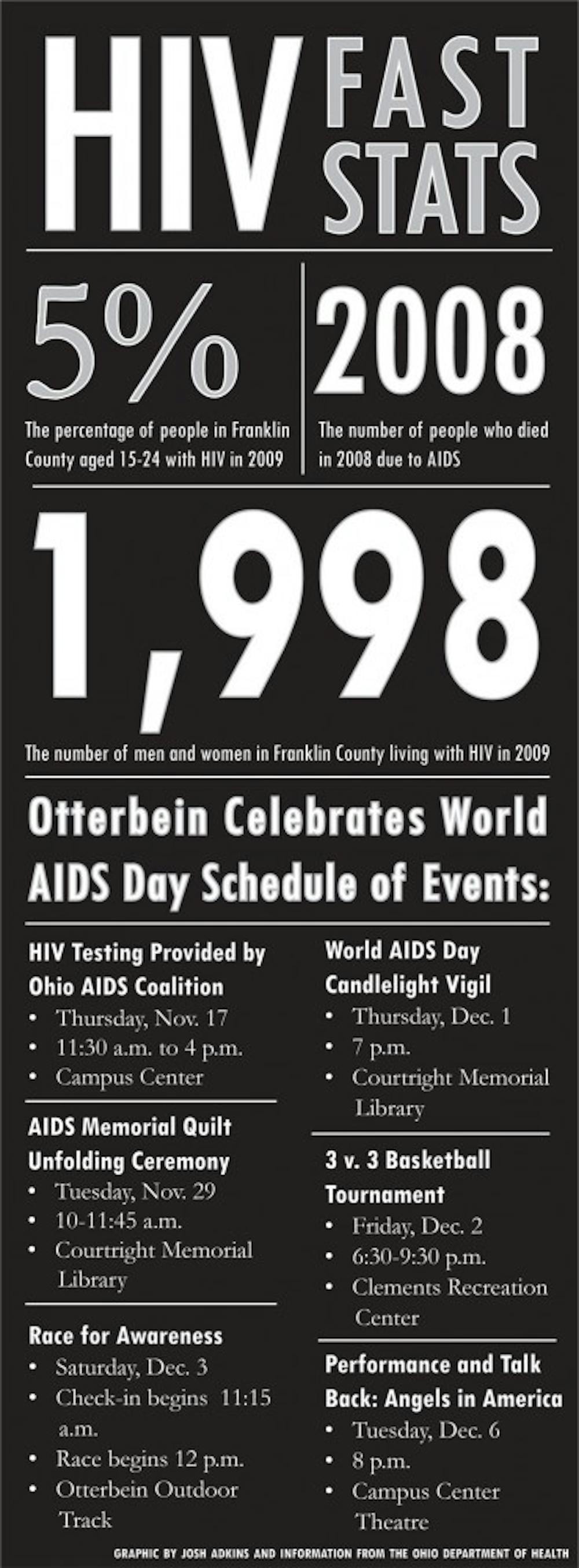
The number 2008 not only represents a year, but also a statistic as the number of AIDS-related deaths that occurred in Franklin County during that time.
Otterbein will be celebrating World AIDS Day Dec. 1 with a series of events that begins with an HIV testing event by the Ohio AIDS Coalition Thursday, Nov. 17.
The purpose of the events surrounding World AIDS Day is to promote awareness regarding HIV and AIDS.
“There are 33 million people in the world that have HIV right now,” Otterbein biochemistry professor Wendy Johnston, who teaches a Senior Year Experience class called The Face of Aids, said. “The conversation regarding HIV and AIDS has gone away in our country because we have the medication that can manage it, but not everyone who has HIV has access to that medication.”
A segment of a quilt representing thousands of people who have lost loved ones to HIV and AIDS will be brought to Otterbein and unveiled Tuesday, Nov. 29, at the Courtright Memorial Library.
“There are currently 91,000 names represented on the quilt. We are fortunate to bring 10 of the 12-by-12 pieces of the quilt to Otterbein for World AIDS Day,” Annie Garrett, a senior enrolled in the course, said. “I hope the quilt will inform more students about HIV and AIDS and truly show them how many people are affected by this virus.”
“Your biggest concern (regarding sex) should not be pregnancy, but should be AIDS, HIV and STDs,” Bill Tiedemann, the program administrator at the Ohio Department of Health, said.
According to Johnston, people are afraid to talk about AIDS or don’t think it can’t happen to them.
“They think it’s a gay disease or an African disease or a drug user’s disease, and the truth is anyone can get it,” Johnston said.
Students in the SYE class were introduced to guest speakers who are HIV positive.
“After having guest speakers in class who are HIV positive, I became quickly aware of how easily anyone can get the virus,” Garrett said.
Johnston said, “We know exactly how HIV is spread through blood and sex, yet the demographics of people who have HIV in this country are under the age of 25. We know how to stop it, yet young people are still getting infected every six seconds.”
Tiedemann said that teens and young adults should treat their sexual health with as much respect as their physical health. “We need to be able to communicate our needs to our sexual partners as we would communicate our needs to our doctor around our physical sex,” Tiedemann said. “We need to be as healthy in our sexual life as we are in our physical life; it’s about protecting ourselves and our futures.”
Statistics show that the most common age group of people living with HIV, AIDS and STDs are between 15 and 24. The Ohio Department of Health came out with a study in 2010 that revealed that 38,517 cases were reported of chlamydia in that age group, 10,846 cases were reported of gonorrhea and 420 cases reported of syphilis.
Sophomore international studies major Kiersten Curtis said that Otterbein does a good job offering information regarding AIDS, HIV and STDs to students. “I don’t think there are a lot of programs, but I know that I have access to info if I want or need it,” Curtis said.
The Health Center is available as a resource for students with issues regarding sexual health. “I haven’t had any students come to me asking for condoms, but we do have them here,” Lee Ann Bowers, administrator and registered nurse at the Health Center, said.
“They expire in January though so until then they can take as many as they need.”

The holidays aren't so happy

Do Christmas on a budget this year