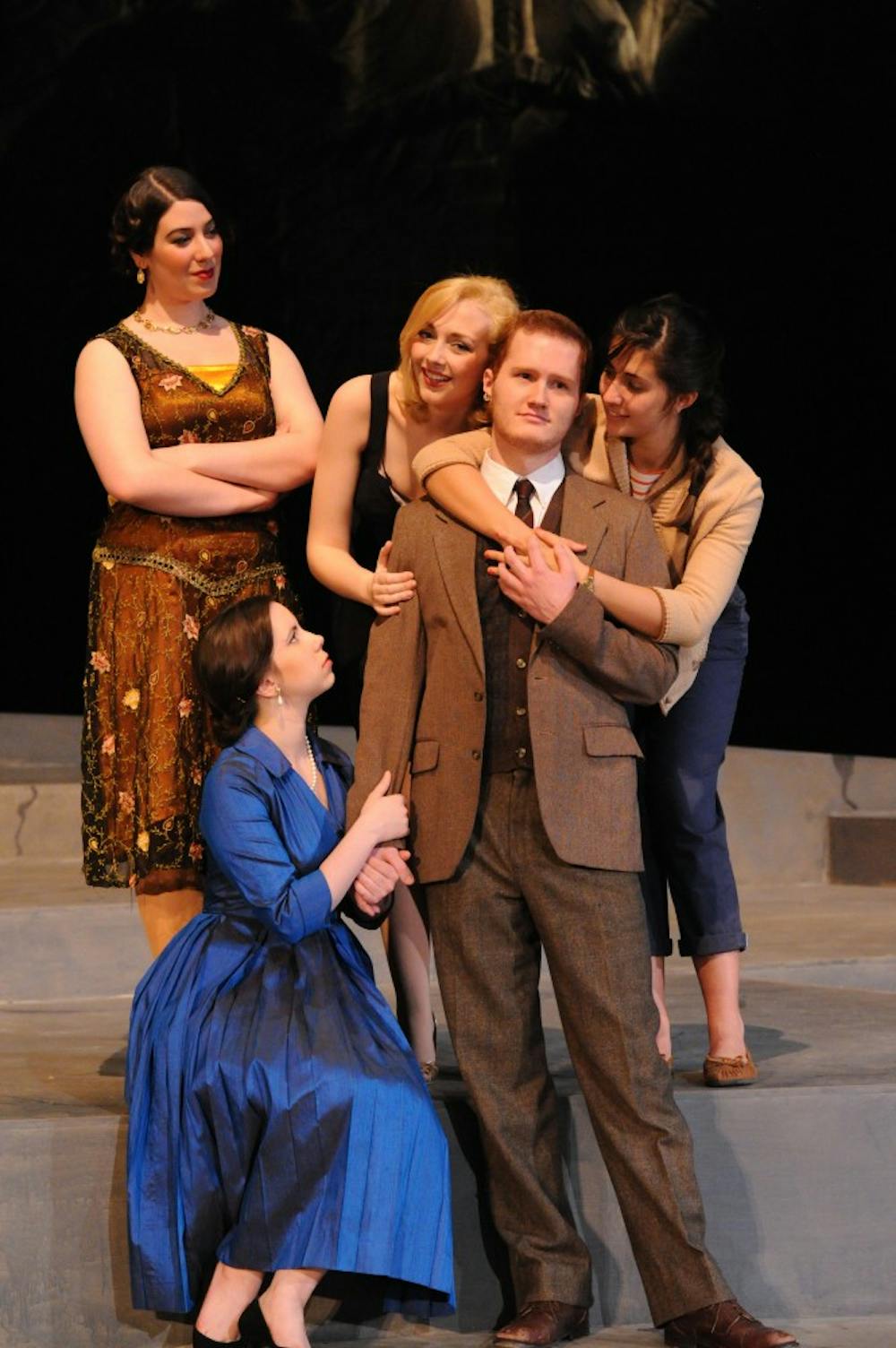
The story of Marilyn Monroe, the famous film and sex icon from the 1950s, is resurrected and modified this month by Otterbein’s Department of Theatre and Dance with its first spring semester performance, “After the Fall.” Critics argue that the play, written by Arthur Miller, was inspired by his failed marriage to Monroe.
“After the Fall,” is told through the eyes of Quentin, an attorney, in a series of flashbacks. He recalls his entire relationship with Maggie, a singing star, from their meeting to their divorce.
As a drama driven by a journey through Quentin’s psyche, it recounts the tumultuous relationship of Quentin and Maggie. The couple’s relationship is often seen as analogous to Miller’s relationship with Monroe, his second wife.
Junior BFA acting major Sam Ray plays Quentin. Ray said that Quentin is not just a character, but serves as a narrator. He tells his story to a friend or therapist, which in this case is the audience itself.
“He’s trying to find himself and what went wrong along the way,” Ray said. “The action of the play is dictated by whatever happens to pop into his head, since the whole play is taking place inside his memory.”
Katie Falter, a senior BA theatre major and assistant director to director Dennis Romer said the show demonstrates the challenge one man faces after experiencing extreme devastation while still continuing to move on with life.
When producing this show, the director wanted the cast and crew keep the connection between Maggie and Marilyn in mind.
“It is hard to remove history from this play,” Falter said. “Reading the first encounter between Quentin and Maggie is so realistic that it is hard to believe that any writer, no matter how good he is, imagined this. It had to have been experienced,” she said.
In Miller’s autobiography “Timebends: a Life,” he said the play was “neither more nor less” autobiographical than any of his other plays. Textual evidence, however, supports otherwise.
Falter, who not only aided Romer with production details but also helped run blocking and cleanup rehearsals, said that the fact that this play was originally produced in 1964, two years after Monroe committed suicide, really contributes to the connection between this play and Miller’s actual life.
Ray said that he approached this production as if it were Miller’s self-psychoanalysis. He said that, because of this theatrical convention, “After the Fall” is unlike any production in which he has acted before, including this past fall’s “Spring Awakening” where he played “adult men.”
He said that while both shows were challenging in their own way, “After the Fall” presented more work, based simply on the size of the role itself.
“Quentin is a huge character with a long journey that he’s got to go on,” Ray said. “The subject matter is very challenging, but that’s part of the fun.”
Besides Ray as Quentin and sophomore BFA acting major Emily Vanni as Maggie, there are several other characters.
These include Quentin’s mother and father, friends of the couple and other girlfriends of Quentin’s, before and after his marriage to Maggie.
In addition to the main cast, Romer added an ensemble to the cast. This ensemble is composed of male and female actors who serve different purposes throughout the drama.
Falter said because of the abstractness of the set, the ensemble acts as an environment indicator.
She said the ensemble should help the audience experience the atmosphere of Quentin’s memories.
Falter offered an example. “Without the ensemble, you would still get the idea of Maggie’s fame, but with the use of the ensemble acting as the crowd, her fame is enhanced,” she said.
Haley Jones, a sophomore BFA acting major, plays multiple characters throughout the ensemble scenes, including crowd members, a wedding guest and “Woman with a Parrot,” which Jones said is her personal favorite.
Jones also said that the ensemble will help create a better sense of environment for the audience.
“The ensemble is made up of a great group of really passionate actors who try their best to bring their own life and energy on stage,” Jones said. “I think the ensemble adds a nice energy to the show.”
Although the ensemble is on stage for a short time, playing ensemble members has still presented a challenge, Jones said.
She said they had to bring what they learned in class to the stage.
While Quentin’s flashback sequences make for an untraditional story flow, Jones said she believes students and other audience members will still appreciate its complexity and its themes of love and loss.
She said she applauds Otterbein on its selection of this heavy show written by one of America’s most well-respected playwrights. While it’s an untraditional play, she said she feels that there’s something in it that everyone can connect to.
“The audience will hopefully appreciate the complexity of the show and, the ultimate goal, be moved in some way from seeing it,” Jones said.
“In my opinion, the goal of theatre is to make the audience think about something – life, love, pain – in a new way. To me, theatre is all about telling stories that need to be told. That’s why I do it, anyway.”
For more information on ‘After the Fall,’ click here.

The holidays aren't so happy

Do Christmas on a budget this year