Otterbein will undergo a comprehensive process of accreditation in the 2014-2015 academic year. The outcome of the process will determine the value of an Otterbein education.
Voluntary accreditation by an outside organization, in this case the Higher Learning Commission, determines whether a school will be recognized as a quality institution. A site visit will occur on Feb. 9 and 10 where review team members from other schools will determine whether Otterbein meets federal requirements.
Wendy Sherman Heckler, associate vice president for Academic Affairs and member of the Accreditation Committee, said that the university’s accreditation matters for students.
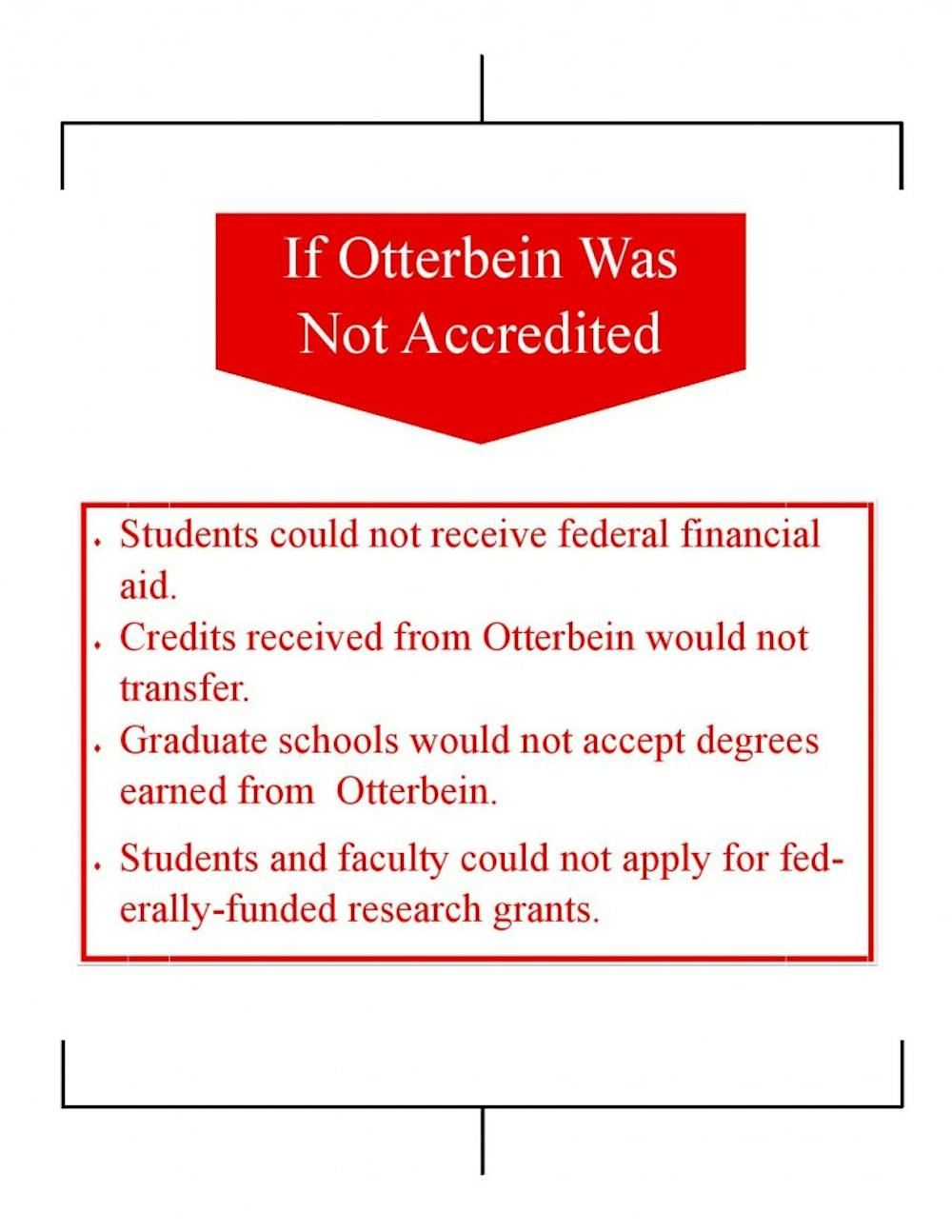
Many universities, including Otterbein, will not accept credits from universities that are not accredited. A degree from an unaccredited institution will not be accepted in graduate schools.
“There are a few institutions, even close by here, that are not accredited institutions that, for example, you can get a degree, you can get a certificate or diploma from this institution to be a Realtor or something like that, and those are not accredited institutions and we would not accept their credits,” Heckler said. “ You wouldn’t be able to use your Otterbein diploma to go to grad school or to transfer credits to another institution if we weren't accredited.”
Otterbein students in need would be unable to receive federal financial aid if the university were not accredited. This is because of the federal government’s requirements for financial aid as listed in Title IV.
An unaccredited Otterbein would be limited in its ability to secure research grants for students and faculty, since many research grants are funded by federal programs.
Considerations for accreditation can factor into how classes are managed. In addition to requiring the use of syllabuses, the federal government also requires that the amount of work required in classes of equal credit hours is the same.
“You can’t be asking them to do elementary school work and give them a college degree.” Heckler said. “It’s not fair if one school says you have to sit in a classroom for 40 hours and then we are going to give you credit for this, and then another class in another school says you only have to sit here for 10 hours and you only have to 10 hours worth of work and we’re going to give you this same type of credit, because you’re supposed to be able to transfer courses from institution to institution.”
Sean Brewster, senior music and business double major and the student representative in the accreditation committee, believes that accreditation is an issue for students as well as faculty. Brewster has helped plan events to increase awareness for accreditation, including a Dec. 5 common hour for students.
“I try to provide the student voice and we try to think of different strategies of how we can inform and engage students on campus through accreditation,” Brewster said.
Brewster said the accreditation process serves as a way for students to celebrate Otterbein and look at what could be changed in the future.
“I do think there is like a negative connotation when it comes to accreditation. I feel that most students think that this is just a reason for us to go to class longer, and that they have longer syllabuses. It’s because we’re getting accredited,” said Brewster. “I challenge that notion that accreditation is bad. I think it’s a good thing for the university.”

The holidays aren't so happy

Do Christmas on a budget this year